A $2.8 Billion Data Center Is Landing on the Old Kohler Site in Spartanburg, and the Upstate Still Cannot Agree on What It Gets
NorthMark's $2.8B AI data center on Spartanburg's former Kohler plant would burn gas for 450-plus MW on site; the jobs and tax numbers in the public record do not match.
The old Kohler plumbing plant at 4000 South Pine Street in Spartanburg stopped making sinks, and now a company called NorthMark Strategies wants to fill its roughly 900,000 square feet with computers and generate more than 450 megawatts of electricity on the property by burning natural gas. A megawatt is roughly enough to power a few hundred homes, so 450 of them is a small power plant sitting behind a converted factory. That single fact, more than the $2.8 billion price tag, is what drew hundreds of people to a state hearing in June, and it is why I went looking for what the Upstate is actually being offered here.
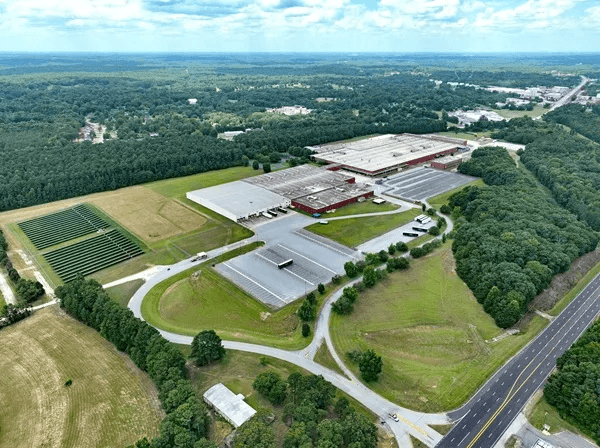
NorthMark is turning the closed Kohler site into a high-performance computing campus, the kind of building that runs the servers behind AI, with initial operations targeted for the second half of 2026 and construction running through 2028. These buildings need two things in enormous quantities, electricity and cooling. The electricity part is where the story turns. The site was first permitted to run 48 megawatts of gas generators, and then on March 4, 2026 the company applied to the state environmental agency to add eleven gas turbines and push on-site generation past 450 megawatts. In other words, rather than pulling all its power from Duke's grid, the campus plans to make most of its own by burning gas on the property. The cooling side moves heat off the chips with water. NorthMark says most of the site recirculates the same water in a closed loop, with a smaller share using an evaporative tower, and that the water is treated on site before it goes into the municipal system. The mechanism is real; the company's framing that the impact is negligible is its own claim, and one estimate in the Post and Courier puts the site's draw near 460,000 gallons a day, which is a single-source number I could not independently verify.
Why did it land here, and why in an old factory? The Upstate sits on the Charlotte-to-Atlanta corridor with fiber already in the ground, land and power cost less than saturated hubs like Northern Virginia, the state waives sales tax on qualifying gear, and a closed manufacturing plant like Kohler already carries heavy industrial zoning and utility service. That last point matters, because it means these projects do not spread out. They cluster on the Spartanburg and Cherokee County corridors where the power and pipes already are, and NorthMark is not alone. Cherokee County has a proposed $2.1 billion Cielo campus, Greer has a Tier III facility, and Duke is building a 1,365 megawatt gas plant in Anderson County, its first new South Carolina generation in a decade, justified partly by this kind of load.
So what does the region get? This is a capital-heavy, labor-light asset, and I want to be honest that the public record does not agree with itself on the size of the prize. On jobs, incentive filings and most reporting cite 27 specialized full-time operating positions, while NorthMark separately says roughly 150 permanent workers at full build. Those two numbers have not been reconciled anywhere I could find, so I am not going to split the difference and pretend I know. On taxes, the company says the site will pay more than $10 million a year, while the county's incentive deal, a FILOT, is described as capping the annual payment near $2 million over a 40-year term. A FILOT, a fee-in-lieu-of-taxes, is an arrangement where a county trades decades of normal property tax for an up-front investment and a capped yearly check. Ten million and two million are a wide gap, and it is unresolved in public. What I can say with confidence is that the durable local benefit is tax base and land reuse, not payroll. A $2.8 billion building employing dozens of people is a lot of money and very few paychecks.
The sharpest tension is power, and it splits cleanly into a part that is fundamental and a part that is still being written. The fundamental part is emissions. Eleven gas turbines burning fuel to make 450-plus megawatts in a residentially adjacent area produces real combustion pollution, which is why the Southern Environmental Law Center flagged air-quality concerns and why hundreds of people packed the June 25 hearing in opposition. Self-generation relieves the grid, but it concentrates the emissions locally, and better policy does not make that go away. The contingent part is who pays for the wider grid. Duke's tariff says a large customer covers the full cost of its own connection to the grid, but upgrades judged to benefit everyone get spread across all ratepayers by usage, and that line between yours and shared is exactly where costs can quietly land on ordinary bills. The state is writing those rules right now through S.867 and a ratepayer-protection bill, H.5215, plus a utilities-commission docket. Until those settle, the protection for residents is a promise, not a finished mechanism, and I want to be clear that no source I found quantifies the effect on a typical Duke bill, so I am not going to assert one. The steelman for the builders is genuine. Real capital is going into a reused brownfield site on a corridor that fits, and Duke's tariff does assign direct connection costs to the user. The case against is just as real. The benefits concentrate and the costs diffuse while the rules are unfinished.
The politics have already turned on this. In February 2026, TigerDC pulled a nearly identical $3 billion project after officials denied its tax deal, and by June several South Carolina counties had enacted moratoriums on new data centers. For all that, the statewide sales-tax breaks these projects use came to about $828,000 for the fiscal year ending June 2025, a figure the revenue agency corrected down from an alarming early report of $828 million.
If you take one thing from this, watch two votes instead of the ribbon cutting. Watch whether the state grants the air permit for the added turbines as filed, and watch whether the legislature settles who pays for grid upgrades before more campuses sign on, because that second decision, not the investment total, is what determines whether the cost reaches a typical bill. For anyone deciding where to live or invest, the practical read is that heavy-industrial neighbors are clustering on the Spartanburg and Cherokee corridors, not in central Greenville, and if you are looking to buy in the Upstate or thinking about selling, tell me what you are working on and I will help you think through what that means for a specific area.
So here is the question I keep landing on. If the tax base is real but the jobs are few and the power and the emissions are unmistakably local, what is the smallest deal the Upstate should be willing to accept before it says yes to the next campus?
Information only, not financial, legal, or investment advice. Figures are current as of 2026 and change over time.
Get the next one in your inbox.
How businesses in South Carolina are actually doing, where the market has been heading, and what is driving both. Subscribe and the next one lands in your inbox.
Prefer Substack? Subscribe there instead.